
Engineering & test
We measure it before you do
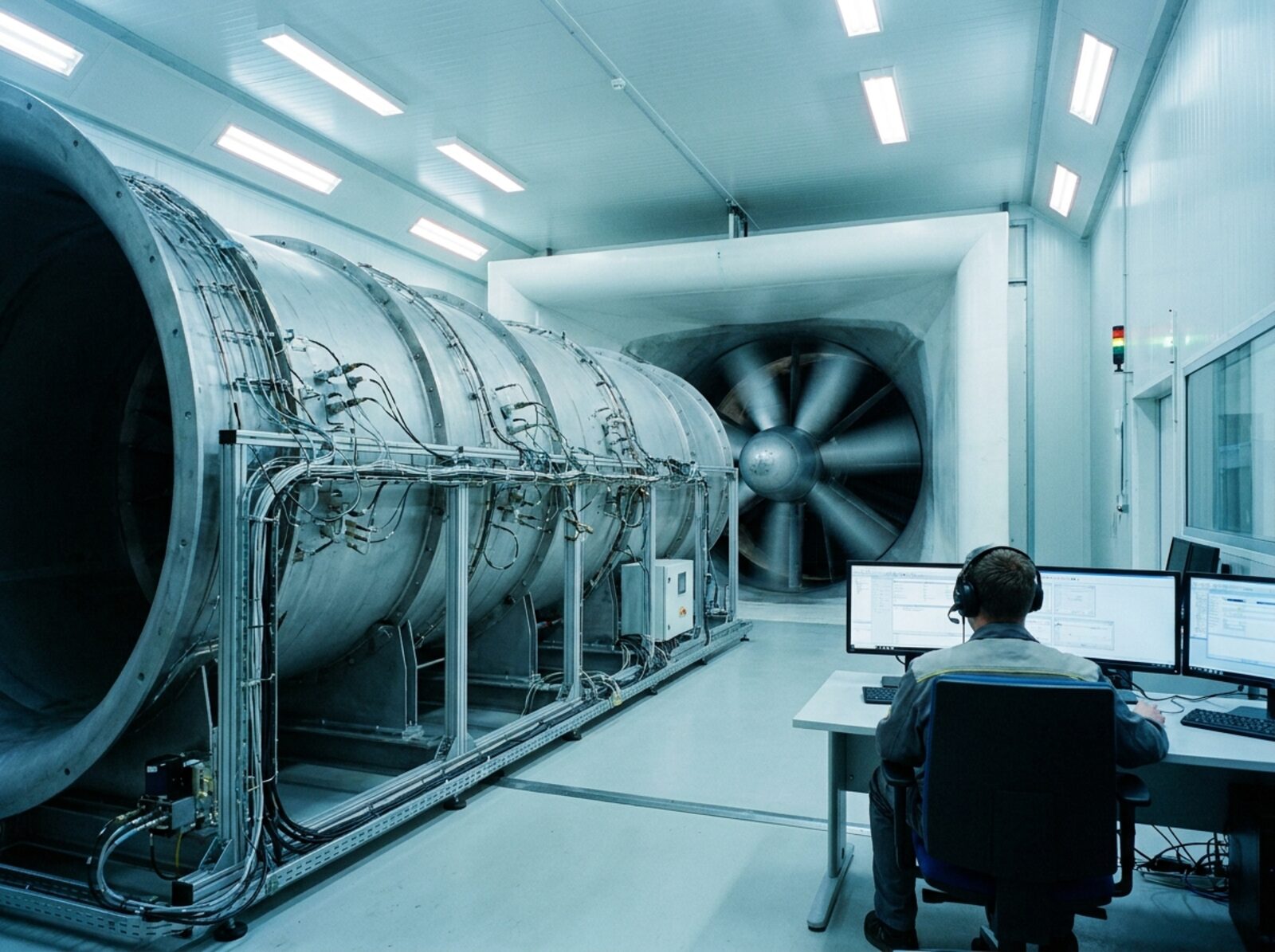
Our test chamber is calibrated to ISO 5801 and was rebuilt in 2026. Every fan runs on it before it ships, and the curve we issue against your order is the one the chamber recorded that afternoon.
Selection and duty
An engineer picks the fan, not a configurator. That means you get a phone call about the system resistance rather than a catalogue page, and it is where most of the running cost of the next fifteen years is actually decided.
Design and drawing
Casings, kerbs, guards and mountings drawn in 3D to your interfaces. General arrangement drawings inside five working days on standard ranges, ten on specials.
Fabrication
Cut, formed, welded and painted in one building in Rotherham. Impellers machined and dynamically balanced on site — we do not subcontract the part that decides whether the fan survives.
Test
Every fan runs on the rig before it ships. Aerodynamic testing to ISO 5801 in our own chamber, with the measured curve issued against the order rather than a catalogue curve reprinted.
Commissioning
On site to set pitch, prove duty and hand over the readings. Two of our engineers are commissioning-qualified, which stops the familiar argument about whose number is right.
Aftercare
Spares held for every fan we have built since 1998, planned maintenance visits, and impeller re-balancing in situ. The oldest unit we still support went in during 1981.
The chamber
What ISO 5801 actually buys you
A fan curve is only meaningful if you know how the air got to the fan. Put the same fan on a rig with a short inlet and a bellmouth and you will read a flattering number; put it behind a bend and you will read a poor one. ISO 5801 pins down the inlet condition, the measurement plane, the nozzle calibration and the settling length so that two curves can be compared.
Our chamber measures volume through calibrated nozzles against a settled plenum, with pressure taps at four positions and a torque transducer on the shaft, so the efficiency figure is measured rather than derived from motor input power and an assumed motor curve.
Reported uncertainty is ±2.1% on volume and ±2.8% on static efficiency across the working range. We will tell you those figures unprompted, because a curve without an uncertainty band is a drawing.
CFD
Modelling, and where it earns its money
We model every impulse ventilation scheme before quoting it, using the structural model rather than an idealised box, and we issue the velocity plots with the quotation. That practice started after two schemes — one in 2021, one in 2023 — left a corner that would not clear, both of which looked entirely reasonable on a plan view.
We also model inlet conditions where a fan has to sit closer to a bend than anyone would like, which is most plant rooms. A centrifugal fan with a bend three diameters upstream can lose 8 to 12% of its static pressure to inlet swirl, and the fix is usually a turning vane costing a few hundred pounds rather than a larger fan costing several thousand.
What we do not do is model an entire building’s smoke strategy. That is a fire engineer’s work and we will say so rather than take the fee.
Issued with every fan
The document pack
- Measured performance curve against your order number
- Balance certificate, with the residual unbalance recorded
- Sound power levels by octave band, measured not calculated
- Motor and bearing data sheets, with greasing intervals
- General arrangement drawing as built, in PDF and STEP
- EN 12101-3 certificate number where the fan is fire-rated
- Declaration of conformity and, for ATEX units, the notified body file
- Spares list with our part numbers and the original manufacturer’s
Next step
Send us the duty and we will send back a curve
Volume, static pressure, air temperature and what is in it. If you only have two of those, ring us and we will work out the rest.